

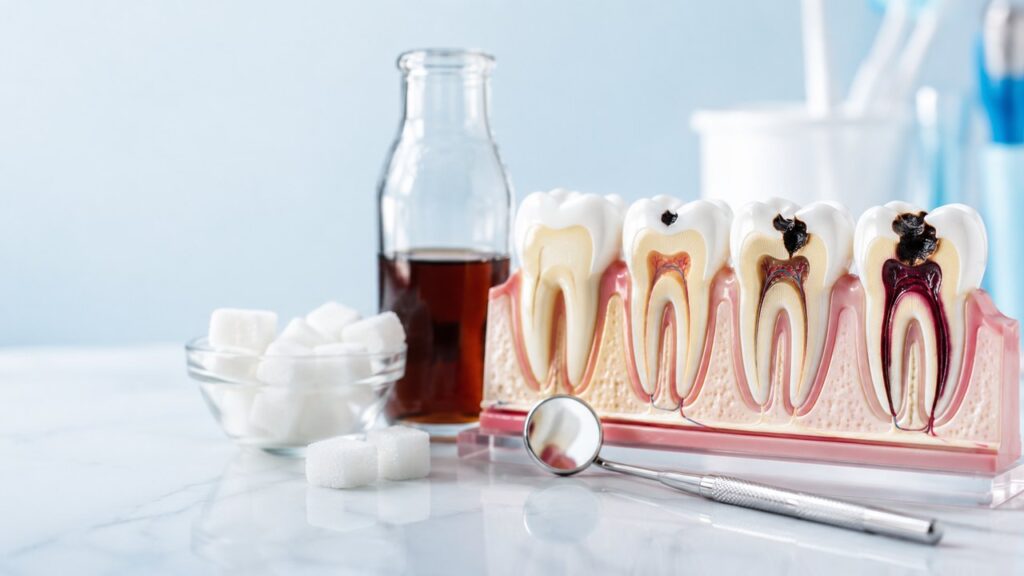
Tooth decay is one of the most common oral and dental health problems in the world and can affect people of all ages. Because it usually progresses slowly, it gives no symptoms in the early stage; when it goes unnoticed, it can reach the depths of the tooth and lead to consequences ranging from pain and infection to tooth loss. The good news is that tooth decay is a largely preventable disease and, when noticed early, can be treated with simple methods. In this comprehensive article we take a detailed look at how tooth decay forms, its causes, stages, symptoms, treatment options and, most importantly, how it can be prevented.
What is tooth decay?
Tooth decay is the gradual destruction of the hard tissues of the tooth due to acids produced by bacteria. Some bacteria naturally present in the mouth produce acid by using the sugar and carbohydrates in the foods we consume. These acids slowly wear away the enamel, the outermost layer of the tooth, and over time lead to the formation of small cavities in the tooth. Decay, which initially affects only the enamel, progresses to the deeper layers of the tooth if left untreated. Tooth decay is not a condition that forms in a single moment; it is a process that develops over time. This process can be stopped and treated when noticed early; for this reason, understanding how decay develops is important for both treatment and prevention.
How does tooth decay form?
The formation of tooth decay occurs through the coming together of several factors. The sticky bacterial layer called plaque, which builds up in the mouth, is at the center of this process. When a sugary or carbohydrate-containing food is consumed, the bacteria in the plaque produce acid by using these sugars. This acid dissolves the minerals in the enamel layer of the tooth, leading to weakening on the surface. This process occurs to some extent after every meal; saliva and fluoride try to maintain the balance by helping the enamel to remineralize. However, when frequent sugar consumption and inadequate oral care disrupt this balance, the acid attacks become dominant and the enamel begins to be permanently damaged. This is the point at which tooth decay forms.
The causes of tooth decay
The main factors that play a role in the development of tooth decay are: frequent sugar and carbohydrate consumption, inadequate or incorrect oral care, plaque buildup, dry mouth (low saliva) and not benefiting enough from fluoride. Frequent consumption of sugary and acidic drinks significantly increases the risk of decay because it exposes the teeth to constant acid attack. Not brushing the teeth regularly and correctly sets the stage for plaque buildup and therefore decay. In addition, the shape and alignment of the teeth and hard-to-reach areas can also affect the risk of decay. Because tooth decay is a multifactorial process, these factors must be addressed together in its prevention. A personalized risk assessment is made by the dentist.
The stages of tooth decay
Tooth decay progresses by affecting the different layers of the tooth in turn. In the first stage, decay affects only the enamel; at this stage, white or dull spots can be seen on the tooth and there is often no pain. As decay progresses, it reaches the dentin layer beneath the enamel; because dentin is softer, decay spreads faster here and sensitivity can begin. If decay deepens further, it reaches the pulp tissue at the innermost part of the tooth, which contains the blood vessels and nerves; at this stage, severe pain and inflammation can develop. In the final stage, the infection can spread to the tissues around the tooth. The earlier decay is noticed, the simpler its treatment and the more easily the tooth is preserved. For this reason, knowing the stages shows the importance of early intervention.
The symptoms of tooth decay
Tooth decay usually gives no symptoms in the early stage; for this reason, regular check-ups are of great importance. The symptoms that can appear as it progresses are:
- Tooth sensitivity: A short-lived twinge felt with cold, hot or sweet foods.
- Toothache: Pain that appears on its own or when chewing, especially in advanced decay.
- A visible hole or spot on the tooth: Brown, black or white color changes or cavities on the tooth surface.
- A bad taste or odor in the mouth: Can be seen in advanced decay.
When one of these symptoms is noticed, it is important to see a dentist without delay to prevent the decay from progressing. Early treatment is both simpler and more protective.
Early-stage decay (white spot)
The earliest stage of tooth decay shows itself with white or dull spots appearing on the enamel surface. At this stage, known as a “white spot lesion,” the enamel has begun to lose minerals but a cavity has not yet formed. This early stage is a critical period in which the decay process can be stopped and can even regress under suitable conditions. With correct oral care, the use of fluoride and bringing sugar consumption under control, the enamel can remineralize. For this reason, noticing early-stage decay is of great importance. Because white spot lesions often cause no pain, they can only be detected during a dental examination; this once again reveals the value of regular check-ups.
Advanced decay and complications
When tooth decay is left untreated, it progresses and leads to more serious problems. When decay reaches the deep layers of the tooth, especially the pulp tissue, severe pain and inflammation can develop. At this stage, root canal treatment is often needed to save the tooth. If the inflammation progresses, a dental abscess can form; this is a condition that shows itself with pain, swelling and infection and requires urgent intervention. In very advanced decay, the tooth may not be saved and extraction may be needed. Tooth loss, in turn, brings other problems with it (such as difficulty chewing and the shifting of neighboring teeth). None of these complications are desired; yet most of them can be prevented by noticing and treating decay early.
How is tooth decay diagnosed?
Tooth decay is diagnosed through an examination by the dentist. The dentist investigates the signs of decay by examining the teeth visually and with special instruments. For early-stage decay or decay in hard-to-see areas between the teeth, X-ray images can be used; X-rays help detect decay inside the tooth and on the interproximal surfaces. This assessment made during regular check-ups allows decay to be noticed while it is still in the early stage. Early diagnosis makes treatment simpler and allows the tooth to be preserved more easily. For this reason, even if there are no symptoms, regular dental check-ups are one of the most effective tools in the fight against decay.
Tooth decay treatment
The treatment of tooth decay varies according to the stage and depth of the decay. In early-stage decay, cleaning the decayed tissue and restoring the tooth with a suitable filling material (a filling) is often sufficient. When decay reaches the depths of the tooth, the pulp, root canal treatment may be needed. In teeth with a great deal of tissue loss, solutions such as a crown can be evaluated. In decay that has progressed too far to be saved, tooth extraction may come onto the agenda. As can be seen, the earlier decay is treated, the simpler and more protective the procedure. Which treatment is suitable is determined by the dentist after a detailed assessment of the condition of the tooth. Early intervention protects both the tooth and time.
The role of fluoride
Fluoride is a mineral that plays an important role in protection against tooth decay. It strengthens the enamel, making the teeth more resistant to acid attacks, and helps the enamel remineralize in the early stage. Brushing regularly with fluoride toothpaste is one of the most effective ways to reduce the risk of decay. The importance of fluoride in protection against tooth decay is also emphasized by organizations such as the American Dental Association (ADA). In some cases, the dentist may recommend additional fluoride applications. However, fluoride alone is not sufficient; it gives the most effective result together with correct oral care, a balanced diet and regular check-ups. It is best to get your dentist’s advice on how fluoride should be used.
Sugar and tooth decay
Sugar consumption is one of the most important factors in the development of tooth decay. Because the bacteria in the mouth produce acid by using sugar, frequent sugar consumption exposes the teeth to constant acid attack. What is decisive here is not only the amount of sugar consumed but also the frequency of consumption. Consuming sugary snacks or drinks frequently throughout the day significantly increases the risk of decay because it does not give the teeth an opportunity to recover. Consuming sugary foods together with meals and less frequently is safer for the teeth. Limiting sugary and acidic drinks in particular is an effective step in preventing decay. Reviewing dietary habits protects both the teeth and general health.
How is tooth decay prevented?
The good news is that tooth decay is a largely preventable disease. The basis of preventing decay is brushing at least twice a day with fluoride toothpaste using the correct technique and using dental floss daily. Avoiding frequent consumption of sugary and acidic foods, especially drinks, reduces acid attacks. Regular dental check-ups allow decay to be noticed while it is still in the early stage. Drinking enough water and preventing dry mouth also play a protective role. For more information on the role of nutrition in dental health, you can review our nutrition for dental health article. A preventive approach reduces both your risk to your teeth and the future need for treatment.
Correct brushing and flossing
The most fundamental tools for preventing tooth decay are correct brushing and the use of dental floss. Teeth should be brushed at least twice a day with fluoride toothpaste and the correct technique. During brushing, care should be taken to clean all tooth surfaces, especially the back teeth and gum margins. However, a toothbrush cannot reach the areas between the teeth; the plaque and food debris in these areas are where decay often begins. This is exactly why daily use of dental floss is of great importance. Dental floss helps prevent the formation of decay in these areas by cleaning the plaque between the teeth. When the habit of correct brushing and flossing is applied together, it provides the most effective daily protection against decay.
Tooth decay in children
Tooth decay is a fairly common problem in children and also affects the baby teeth. Although decay of the baby teeth is sometimes seen as unimportant, in reality it can affect the child’s nutrition, speech and the health of the permanent teeth. Among the main causes of decay in children are frequent consumption of sugary foods and drinks and inadequate oral care. Brushing children’s teeth regularly and correctly, limiting sugar consumption and starting dental check-ups from an early age are of great importance in preventing decay. You can also benefit from our content in which we cover the subject of tooth decay in children in more detail, and you may not want to skip regular check-ups for your child’s dental health. Early habits form the foundation of a healthy smile that will last a lifetime.
The importance of regular dental check-ups
One of the most effective tools in the fight against tooth decay is regular dental check-ups. Because decay usually gives no symptoms in the early stage, it is often noticed only during an examination. Regular check-ups allow decay to be detected at the stage where it is still affecting the enamel and its treatment is simplest. In addition, the dentist can assess the person’s risk of decay, offer preventive recommendations and perform professional cleaning. It is also stated by the World Health Organization that tooth decay is one of the most common but largely preventable health problems in the world. Regular check-ups are the most reliable way both to catch decay early and to protect general oral health.
Common misconceptions about tooth decay
One of the most common misconceptions about tooth decay is that decay should only be treated when it causes pain; in reality, pain is often a sign that the decay has progressed, and early treatment is much more protective. Another misconception is that decay in the baby teeth is unimportant; in reality, it can affect the child’s health and the permanent teeth. In addition, it is thought that only sugar causes decay; in reality, decay forms through the coming together of sugar frequency, oral care and other factors. It is also wrong that decay is inevitable; it can be largely prevented with correct care. The most reliable way to reach accurate information is to consult a dentist.
Frequently Asked Questions
How does tooth decay form?
The bacteria in the mouth produce acid by using the sugar in foods. This acid wears away the enamel and over time decay forms. Frequent sugar consumption and inadequate care speed up the process.
Can tooth decay occur without pain?
Yes. Early-stage decay usually causes no pain; for this reason, it is often noticed only during a dental examination. This is why regular check-ups are important.
Can early decay be reversed?
In very early decay at the white spot stage, the enamel can remineralize with correct care and fluoride. Once a cavity has formed, a treatment such as a filling is needed.
How is tooth decay treated?
In early decay, a filling is often sufficient. If decay reaches the pulp, root canal treatment may be needed; if it has progressed too far, extraction. Early treatment is simpler.
How is tooth decay prevented?
Brushing twice a day with fluoride toothpaste, daily flossing, limiting sugar consumption and regular dental check-ups are the most effective measures.
Is decay in baby teeth important?
Yes. Decay in the baby teeth can affect the child’s nutrition, speech and the health of the permanent teeth; it should not be neglected.
To protect against tooth decay or to have an existing cavity treated, you can book an appointment at Beyaz Köşe Oral and Dental Health Clinic for a detailed assessment.